Tools
Understand what an equipment inventory can and cannot calculate
Add entered equipment values without mistaking the sum for a code load calculation.
Give every number a meaning
For each appliance or proposed device, record the model, the source of its value, the unit and quantity. A manufacturer's input rating, an expected operating measurement and an annual energy estimate describe different things. Keep them separate. If the value is unavailable, request it instead of guessing from a similar product or from the branch breaker.
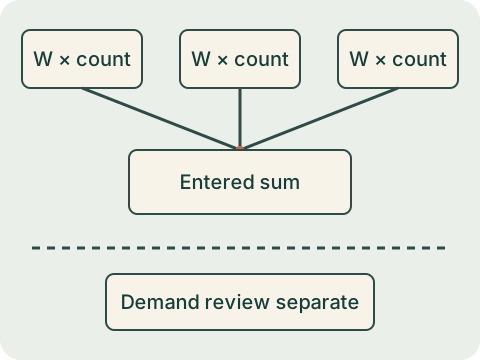
The inventory tool adds watts multiplied by the entered number of units. It reports that arithmetic explicitly. A zero quantity means the item is not included in the entered scenario. It does not prove an appliance is disconnected or that a service has spare capacity.
Separate the arithmetic from electrical design
Equipment does not necessarily operate simultaneously or in the same mode. An applicable load calculation may use methods and information beyond a raw nameplate list, and the existing service also needs evaluation. State and local requirements and utility review belong to the qualified project's process. The tool supplies none of those approvals.
Do not divide the inventory total by an assumed voltage and call the result a recommended panel size. Similarly, do not subtract it from the printed main rating to claim usable headroom. Record the proposed equipment and ask the responsible electrical professional to explain the actual method, inputs and limitations used for this property.
Use scenarios to improve the conversation
Make separate saved records for the current known equipment and a proposed future set. A proposed heat pump, water heater or charger can be listed before its technical feasibility is known. Keep undecided products and their uncertain values visible. This gives the reviewer a useful project picture without forcing a premature design choice.
The editable brief includes every entered equipment label, value and quantity, the exact sum, units and the tool's limitations. Add the questions you want answered before sending or discussing it. If equipment is substituted, recalculate rather than editing the old result into an unsupported conclusion.
A worked planning example
For a deliberately illustrative inventory, an entered 1,200 W item with quantity two contributes 2,400 W, and an entered 800 W item with quantity one contributes 800 W. The tool reports 3,200 W as the entered sum. Those invented example values are not product recommendations, typical household loads or a service design.
If the second item's manufacturer value is later corrected to 900 W, the revised sum is 3,300 W. Preserve both records and the corrected source. Neither result selects a panel rating or proves spare capacity. The useful change is that the electrical reviewer receives a traceable list rather than an unexplained total.
Keep in your brief
- A watt sum is an inventory total.
- No service size or remaining capacity is calculated.
- Retain manufacturer references and uncertainty.
Primary references
- Electricians compliance guide — TDLR
Texas
- Electric service standards — CenterPoint Energy
CenterPoint electric service territory, where applicable