Local process
Separate Houston permits, Texas licensing and utility review
Build a responsibility record for the actual address and proposed electrical work.
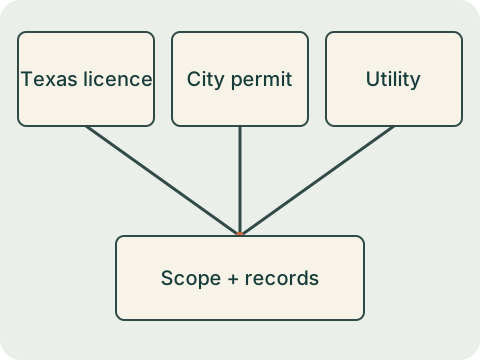
Start with the scope and address
Describe what is being proposed before asking for a permit answer: a panel replacement, a service change, an added circuit or a larger equipment project. These descriptions are different starting points and can overlap. Record the property address, current use, equipment proposed and any available records. A plan to add capacity is a question for review, rather than proof that a particular service size is necessary.
Houston's permitting information identifies a local electrical permit and registered applicant context. Texas licensing and utility coordination are separate checks. A state exemption, an online calculator or a contractor's informal estimate should not be substituted for the City's response to the actual work. Ask which approvals and inspections apply, who applies and which documents are required.
Verify the entity responsible for work
Request the name of the electrical contracting entity and the licence information of the parties proposed to perform and supervise the work. Use the official TDLR licence search and confirm any Houston registration relevant to the application. Save the result date with the written proposal. A planning intake brand or a referral conversation is not evidence that a particular Houston electrical contractor has been engaged.
Ask the proposal to distinguish design, application, field work, inspection scheduling and utility contact. If a different party will perform an item, record that party rather than treating 'included' as a complete answer. Confirm how responsibility will be handed over if the project is phased or the original proposal changes.
Keep decisions and documents traceable
Use a small register with the authority, request date, question, response and unresolved conditions. Distinguish an application submitted from an approval issued, and an inspection requested from a final record received. Those statuses preserve evidence; they do not certify that the installation complies.
Before dependent work begins, have the responsible parties reconcile the current scope with the authority and utility requirements. At closeout, collect the applicable permit, inspection and service documents for this project. The useful result is a clear chain of responsibility and open questions, without promising a processing time or an approval outcome.
A worked planning example
A homeowner considering a charger and a panel replacement sends one short equipment list to the proposed electrical contractor. The contractor describes two scopes, while the homeowner initially assumed they were one task. The useful next step is to reconcile those scopes and ask who handles each local and utility requirement. It is not to select a permit category from a generic article.
The record can preserve the contractor's licence verification, the City's response and the utility request separately. If the product changes, the responsible parties should decide which documents need revision. An application receipt remains an application receipt until the relevant approval or final record is actually provided.
Keep in your brief
- Use the actual address and scope.
- Verify actual trade entities independently.
- Track submission, approval and final records separately.
Primary references
- Electrical meter and loop service permit — Houston Permitting Center
Houston, Texas
- Permits — Houston Building Code Enforcement
Houston, Texas
- Electricians — Texas Department of Licensing and Regulation
Texas
- Consumer protection: electrical work — TDLR
Texas
- Electric service request — CenterPoint Energy
CenterPoint Houston electric service territory, where applicable