Records
Record flood or weather concerns for the proper safety response
Keep damage observations out of routine capacity calculations.
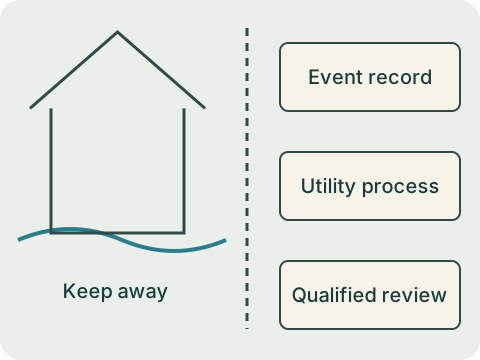
Treat an immediate hazard as an immediate response
A downed line or visibly damaged electrical equipment is not a planning-calculator problem. Use official emergency and utility instructions and keep away from hazardous equipment. HAUSE intake is a project contact, not a claimed emergency response provider or restoration authority.
Record the event date, location and information already available without approaching equipment to improve the record. Photos taken previously or from an ordinary safe position may help the responsible party, but the guide does not ask the homeowner to inspect damaged electrical assemblies.
Do not infer recovery from apparent operation
CPSC's dated flood warning explains why submerged protective electrical devices should not be trusted merely because they dried or seem to work. Keep that historical warning's scope clear and ask a qualified party for the actual equipment assessment and replacement requirements.
Document reported water exposure and previous repair information as separate entries. Do not diagnose an entire electrical system from a stain or photograph. Likewise, do not use the absence of a visible mark as evidence that concealed equipment was unaffected. The record should preserve uncertainty for the appropriate assessment.
Coordinate equipment and utility questions
Ask the relevant parties to identify which customer equipment, utility work and local approvals are involved. CenterPoint's Houston equipment guidance is context where that utility applies, but the actual address and damaged components must be confirmed. Keep utility restoration and qualified repair records distinct.
If a later improvement project is being considered, create a separate scope after the immediate response and assessment. Do not merge a repair need with a recommendation for a particular capacity. Save findings, limitations, approved scope and applicable final records. The useful handoff contains observations and questions, rather than a remote declaration that equipment is safe or service can be restored.
A worked planning example
After a weather event, a homeowner has a dated photograph and a reported water level but no equipment assessment. Those facts can be recorded without approaching the equipment or attempting to prove that it still operates. The immediate response should follow the relevant official safety and utility process.
Later, the qualified assessment may define repair work and additional questions. Save the actual findings and scope with their limitations. If the homeowner also wants future equipment, create another planning scenario rather than treating damage as proof of a capacity requirement. A restoration record and a future-project record serve different purposes and should remain traceable.
Keep in your brief
- Use official hazard channels.
- Apparent operation is not a clearance.
- Separate immediate response from improvement planning.
Primary references
- Downed power lines — CenterPoint Energy
Houston utility safety context
- Electrical equipment safety — CenterPoint Energy
Houston utility safety context
- Flood-damaged electrical controls warning — CPSC
United States; dated official safety warning